M4 Coupé
A 3.0-liter twin-turbo inline-six.


2015 US base specification · Factory source

Every figure, in one place.
Performance
- Power
- 431 PS · 425 hp · 317 kW
- Torque
- 550 Nm
- 0–100 km/h
- 4.3 s
- Top speed
- 250 km/h · limited
- Power-to-weight
- 3.47 kg/PS
Engine and drivetrain
- Engine
- S55 · Inline-six
- Displacement
- 2,979 cm³
- Induction
- Twin-turbo
- Redline
- 7,600 rpm
- Gearbox
- 6-speed manual / 7-speed M DCT
- Drivetrain
- Rear-wheel drive
- Powertrain
- Petrol
Body and dimensions
- Production
- 2014–2020
- Body
- Coupés
- Length
- 4,671 mm
- Width
- 1,870 mm
- Height
- 1,383 mm
- Wheelbase
- 2,812 mm
- Kerb weight
- 1,497 kg
- Fuel tank
- 60 L
Where this car ranks across all 93 cars in the catalogue.
Why you’d want one
- A turbocharged M coupé.
Know before you buy
- Crank hub concern under extreme tuning loads
- Plastic charge pipes can split when boost is raised
- Rear tyre wear is high
Commonly reported ownership points, not a guarantee of faults. Always get an independent inspection.
The M coupé gains a new number.
The F82 carries the M4 name for the two-door M car. It shares the S55 family with the F80 M3, while the coupé body gives the same engine chapter a different silhouette.
A turbocharged M coupé.
Two-door access is less convenient for frequent rear passengers.
The M4 name did not mean BMW added two cylinders.
S55 · Inline-six
A 3.0-liter twin-turbo inline-six. The S55 combines direct injection, Valvetronic and Double VANOS.
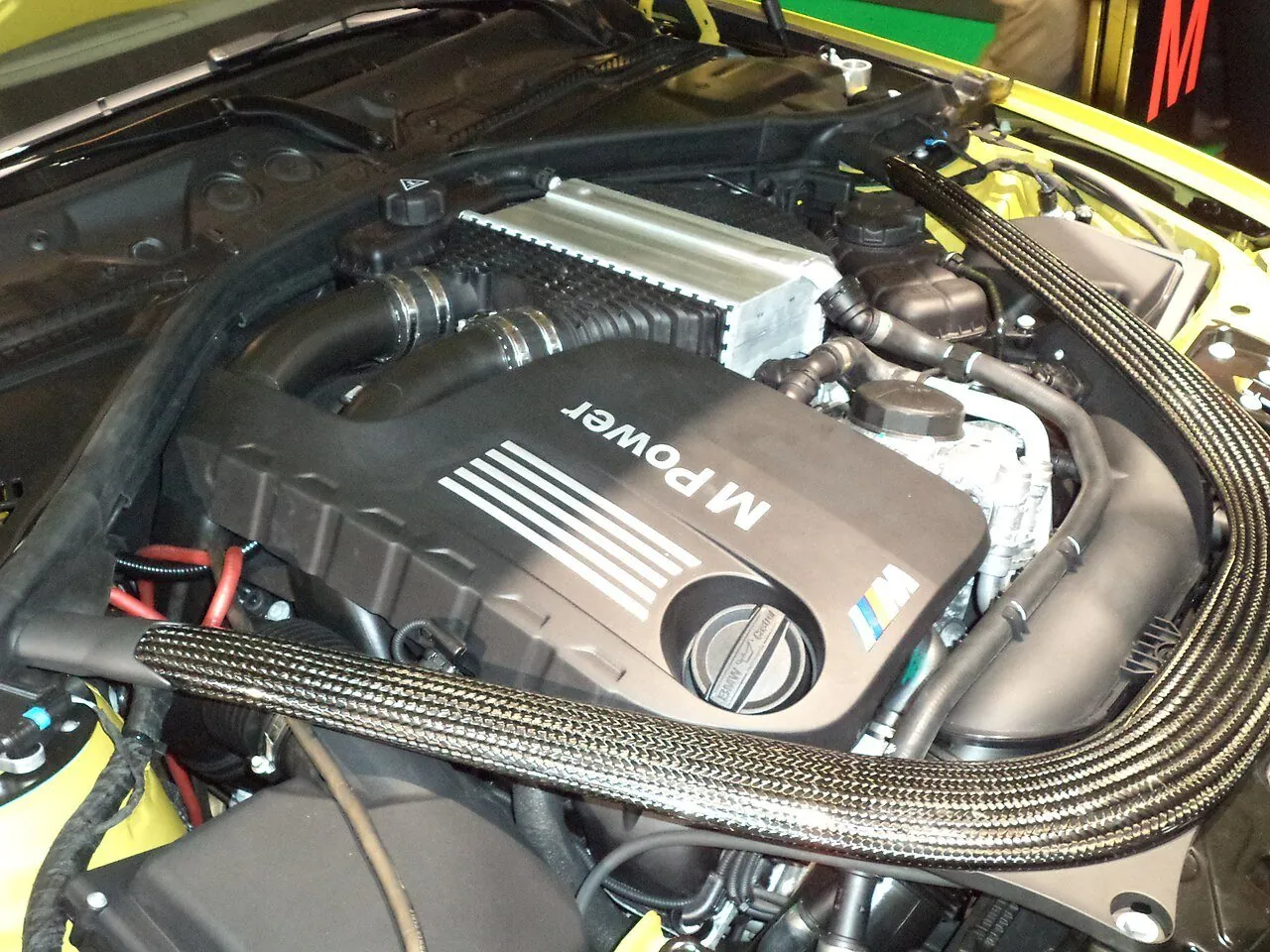
S55 engine-family reference photographed in an M4. Engine covers and bay details may differ from the selected model.
The M straight-six returns.
The S55 is a longitudinal 3.0-liter inline-six. The 2015 US base M3 and M4 share the 425 hp and 406 lb-ft factory rating.
Two turbochargers.
Two mono-scroll turbochargers compress intake air. TwinPower Turbo is a BMW technology name, not a universal statement about turbo count.
Water-to-air charge cooling.
A charge-air cooler transfers heat from compressed intake air to a separate coolant circuit before the air reaches the engine.
Lift and timing.
Valvetronic varies intake-valve lift. Double VANOS changes camshaft timing. Both help control breathing across the rev range.


